

Hey there,
One thing I’m sure plenty of you have seen…
Most pitch decks follow the same formula: problem, solution, market size, traction, team, financials, ask.
And most investors sit through dozens of these pitches every week, nodding along, taking notes, and thinking about all the ways your business could fail.
They’re trained to be sceptical. It’s their job to poke holes in your plan.
So what if, instead of waiting for them to ask about risks, you addressed them head-on?
That’s exactly what I did. I added a “Risk Mitigation” slide to my pitch deck — and it completely changed how investors responded to Mane Hook-Up.
Instead of seeing me as another over-optimistic founder, they saw me as someone who thinks critically about the business and has a plan for survival, not just growth.
Here’s why this “anti-pitch” slide works and how you can create your own.
The Problem I Was Solving
Before I added this slide, I kept getting the same pushback during pitches:
“What happens if a competitor launches this first?”
“How do you plan to acquire customers at scale?”
“What if the market isn’t as big as you think?”
I was spending half the pitch playing defence, scrambling to answer objections I hadn’t prepared for. It made me look reactive instead of strategic.
I realised I needed to address these risks directly — not at the end of the pitch when an investor brings them up, but proactively, as part of my story.
What Is the Risk Mitigation Slide?
The Risk Mitigation slide is exactly what it sounds like: a slide that highlights the biggest risks to your business and explains how you plan to survive them.
It’s “anti-pitch” because most founders only talk about upside. They paint the rosiest possible picture and hope investors don’t ask hard questions.
But this slide does the opposite. It says: “Here are the things that could go wrong. And here’s why we’ll survive anyway.”
Where Does It Appear in the Deck?
I place it strategically depending on the investor and the context:
In the main deck (slides 10-12): If I expect a lot of pushback or if I know the investor is particularly risk-focused. This way, I control the narrative before they bring up concerns.
In the appendix: If I don’t expect much pushback or if the conversation is flowing smoothly. I keep it ready in case someone asks about risks, but I don’t lead with it.
The key is flexibility — you want to address risks, but you also want to read the room.
What Goes on the Slide?
Here’s the structure I use:
Title: “Risk Mitigation” or “How We Plan to Survive”
Format: 3-4 major risks with clear mitigation strategies for each
Example from Mane Hook-Up’s deck:
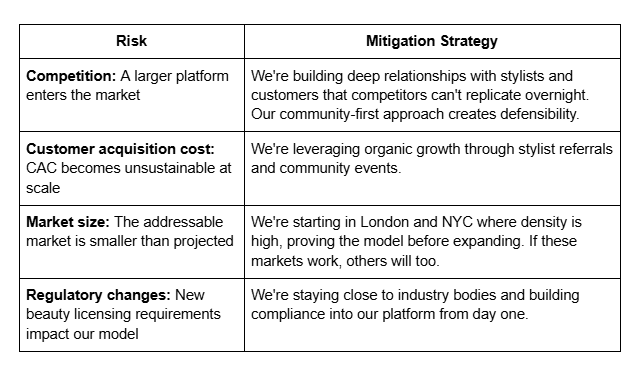
The slide doesn’t sugar coat anything. It acknowledges real risks but shows you’ve thought through survival strategies.
Why This Works
1. It shows you’re not delusional
Investors meet founders every day who believe nothing can go wrong. When you acknowledge risks upfront, you immediately stand out as someone who thinks critically about the business.
2. It builds trust
By being transparent about weaknesses, you demonstrate honesty. Investors appreciate founders who aren’t hiding problems — they want to work with people who see reality clearly.
3. It reframes the conversation
Instead of investors grilling you on risks at the end (when they’re sceptical), you’re addressing them proactively (when they’re still engaged). This puts you in control of the narrative.
4. It demonstrates strategic thinking
Anyone can talk about the upside. But showing that you’ve thought through downside scenarios and have mitigation plans? That’s what experienced founders do.
Investor Reactions
The response has been overwhelmingly positive.
A lot of investors love the fact that I’ve thought this through. It makes our case stronger, not weaker.
Some have told me they’ve never seen a founder include a risk slide in the main deck — and that alone made them take me more seriously.
Has it changed conversations from sceptical to excited? Yes. A lot.
When investors see that I’m not just pitching a dream but building a resilient business, they lean in. They start asking “how can I help?” instead of “what if this doesn’t work?”
How to Create Your Own Risk Mitigation Slide
Step 1: List your biggest risks
Be honest. What keeps you up at night? What would investors worry about? Common categories:
Competition
Customer acquisition costs
Market size
Regulatory challenges
Team/execution risk
Technology/product risk
Step 2: Identify your mitigation strategies
For each risk, answer: “How will we survive if this happens?”
Don’t just say “we’ll figure it out.” Be specific:
What are you doing now to prevent this risk?
What’s your backup plan if it happens anyway?
Why are you positioned to weather this better than others?
Step 3: Keep it concise
This slide should be scannable. Use a table or bullet points. Don’t write paragraphs.
Step 4: Decide where to place it
Main deck if you expect pushback. Appendix if you want to keep the main pitch optimistic but have it ready.
Your Quick Start
This week:
Open your pitch deck
Create a new slide titled “Risk Mitigation”
List 3-4 major risks to your business
Write one mitigation strategy for each
Decide if it belongs in the main deck or appendix
Your timeline:
Week 1: Draft the slide and test it with an advisor or friendly investor
Week 2: Refine based on feedback
Week 3: Use it in your next investor pitch and observe the reaction
Week 4: Adjust placement (main deck vs appendix) based on how conversations go
Pro tip: Don’t list every possible risk — focus on the 3-4 that investors are most likely to ask about. This keeps the slide focused and prevents you from looking overly anxious.
The Real Impact
Adding this slide didn’t just change how investors saw Mane Hook-Up — it changed how I thought about the business.
By forcing myself to articulate risks and mitigation strategies, I became a more strategic founder. I stopped pushing problems aside and started planning for them.
And investors noticed.
If you want to stand out in a sea of overly optimistic pitch decks, try the “anti-pitch” slide. It might be the most honest thing in your deck — and that’s exactly why it works.
Let me know how investors react when you use it!
Ciao for now,
— Jade